HVAC AI Answering Service: The Complete 2026 Guide
Everything HVAC contractors need to know about AI answering services in 2026 — how they work, what they cost, and how to evaluate one. Free Revenue Leak Audit inside.
hvac ai answering servicehvac automationlead recovery
HVAC AI Answering Service: The Complete 2026 Guide
HVAC AI answering services close the loop between a missed call and a booked appointment.
If you run an HVAC business, you already know the pain: the phone rings while your tech is crawling under a crawl space. You miss the call. The homeowner hangs up and calls the next number on Google. That job — maybe a $600 tune-up, maybe a $12,000 system replacement — is gone.
HVAC AI answering services were built to fix exactly this. But with a dozen options on the market and vendors promising everything from "human-sounding AI" to "100% booking automation," it's hard to know what's real and what's marketing fluff.
This guide cuts through the noise. By the end, you'll know exactly what an HVAC AI answering service does, how to evaluate one, what you should expect to pay, and how to calculate the ROI before you sign anything. Plus a free Revenue Leak Audit you can run on your own numbers in 60 seconds.
TL;DR
An HVAC AI answering service calls back missed callers in under 8 seconds, qualifies the lead, captures complete structured booking details in a paste-ready handoff for your ServiceTitan / Housecall Pro / Jobber dispatcher (direct API booking is rolling out per platform), and flags emergencies — 24/7.
The cost of the problem it solves: HBR's lead-response research shows 78% of customers book with the first responder. Industry call audits put HVAC missed-call rates at 25–40%. The math typically lands between $150K and $500K of annual revenue leaked for a mid-size shop.
Evaluation criteria that actually matter: dispatch-software integration, callback speed under 60s, configurable emergency routing, bilingual support, handoff quality, HVAC-specific training.
Implementation timeline: 5–10 business days from contract to go-live for most reputable vendors.
Run the math on your own numbers:free Revenue Leak Audit — 60 seconds, full PDF in your inbox.
The short version: AI answering services aren't "another tool." They're the difference between catching a $400 service call at 9:47 PM on a Saturday or losing it to the next contractor in the Google results. Speed wins. AI is faster than humans. That's the entire pitch.
What Is an HVAC AI Answering Service?
An HVAC AI answering service is software — usually powered by a large language model (LLM) combined with voice synthesis — that answers or returns phone calls on behalf of your HVAC business.
But calling it an "answering service" undersells it. Unlike a traditional human answering service that takes a message and emails it to you, a modern AI answering service:
Calls back missed calls in seconds — the machine-verified benchmark is under 8 — before the homeowner calls your competitor.
Qualifies the lead — asks what they need, their address, urgency, preferred time.
Captures structured booking details — service type, address, urgency, preferred window, contact info — in a clean handoff your dispatcher can paste into ServiceTitan, Housecall Pro, Jobber, or FieldEdge in under 30 seconds. (Direct API booking is rolling out per dispatch software, beginning with Housecall Pro and Jobber.)
Transfers urgent calls — gas leaks, no heat in winter, no AC in a heat wave — directly to your on-call tech line.
Hands off non-bookers — every conversation is logged with full transcript so your team can run your existing follow-up cadence without re-qualifying from scratch.
The key difference: the AI doesn't just take a message. It closes the loop.
How Does HVAC AI Answering Actually Work?
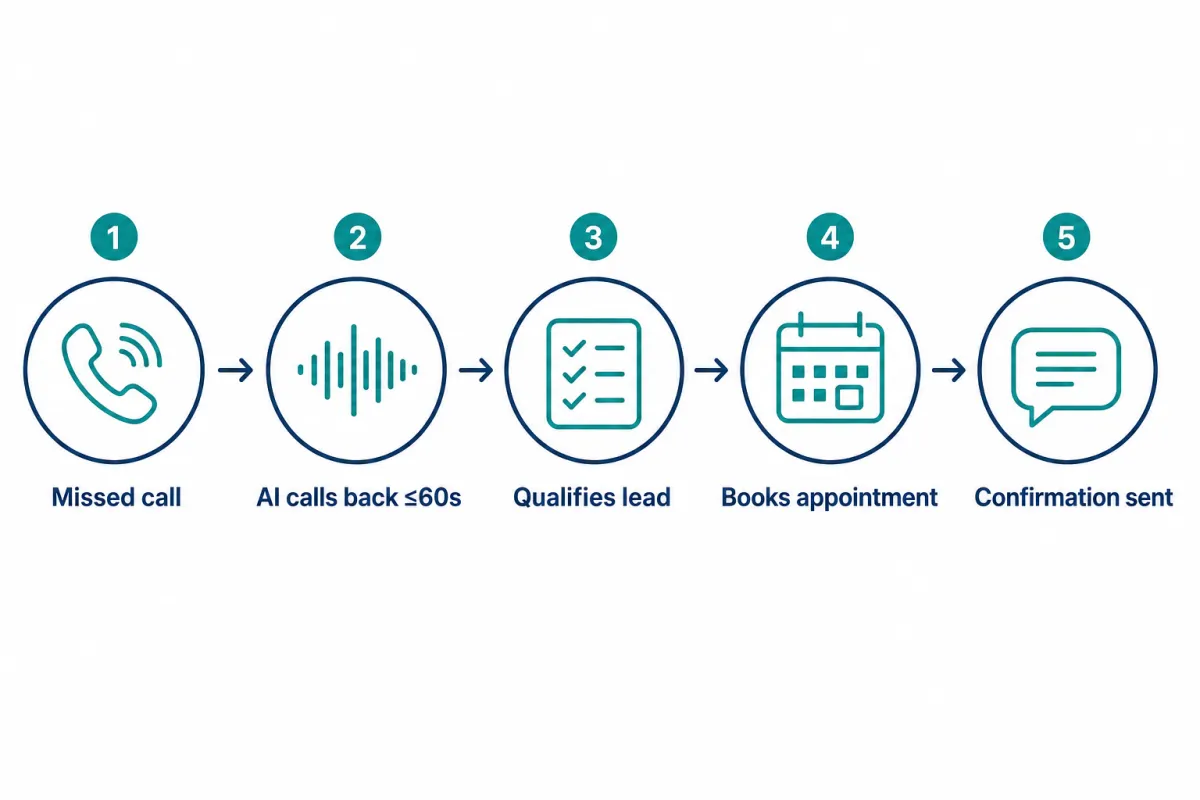
Here's the technical flow, explained simply:
Missed call triggers the AI. Your phone forwards missed calls to the AI system. This can be a call-forwarding rule on your existing number — no hardware changes required.
AI calls back in under 8 seconds. The AI dials the missed caller's number from your business line or a local number you configure. When the homeowner picks up, they hear a natural-sounding voice introducing itself as calling from your company.
Conversation and qualification. The AI handles the conversation in real-time using natural-language processing. It asks what type of service they need, their zip code, their availability, and any urgent details. If they mention a gas leak or carbon monoxide alarm, it flags as an emergency immediately.
Appointment handoff. The AI captures all the details your dispatcher needs — service type, address, urgency, preferred time window, contact info — and surfaces them in a clean handoff your team can paste into your dispatch software in seconds. Direct API booking to Housecall Pro and Jobber is rolling out; ServiceTitan and FieldEdge are on the roadmap. The customer gets a confirmation text once the job is on the board.
Handoff for anything complex. If the conversation goes outside what the AI is trained for, it captures everything and routes to a human — either live transfer or a callback from your office.
HVAC AI answering service flow: from missed call to confirmed booking in five steps, with the callback firing in seconds.
💡 The speed window matters because of math, not preference.Harvard Business Review's analysis of 2,241 U.S. companies found contacting a lead within an hour made firms 7x more likely to qualify it than waiting 24 hours — and 60x more likely than waiting more than 24 hours. The five-minute mark is where the curve breaks.
AI vs. Human Answering Service: The Real Comparison
Let's be direct about the differences.
Capability
Human Answering Service
HVAC AI Answering Service
Monthly cost
$400–$1,200 (typical)
Varies by vendor and call volume — judge against recovered revenue, not line-item cost
Hands off structured booking to ServiceTitan / Housecall Pro / Jobber
❌ (free-text message only)
✅ Structured handoff today; direct API booking rolling out per platform
Calls back missed calls automatically
❌
✅ In seconds — the machine-verified benchmark is under 8
24/7/365 coverage
Limited / surcharge
✅ Native
Emergency routing (gas leak, no heat)
Manual escalation
✅ Configurable, instant
Average response lag
Hours
Seconds
Handles Spanish-speaking callers
Sometimes (extra fee)
✅ Native multilingual
Sick days / turnover / holidays
Yes
No
Trained on HVAC-specific dispatch logic
Generic scripts
✅ Service vs. install vs. maintenance
Captures full transcript every call
❌ (notes only)
✅ Audited transcript
The math is simple: if a homeowner calls at 9 PM on a Saturday with a broken AC, a human answering service takes a message. An AI calls them back in seconds, books Tuesday morning, and the homeowner wakes up with a confirmation in their inbox. You wake up with a booked job.
Let's run the math for a typical HVAC contractor. (Want this done with your real numbers? Skip to the Revenue Leak Audit.)
Scenario: Mid-size residential HVAC company
8 service trucks
30–50 inbound calls per week
Average ticket: $450
Estimated missed calls per week: 15 (conservative — industry studies put HVAC miss rates at 25–40%)
Metric
Without AI
With AI (65% recovery)
Missed calls per week
15
15
Calls recovered
0
9.75
Average ticket
$450
$450
Weekly recovered revenue
$0
$4,388
Annual recovered revenue
$0
$228,150
Annual revenue leak
~$351,000 at 100% miss; ~$70,200 even at 20% callback close
Recoverable
That's not hypothetical. That's the math for a real company missing calls right now. Every week they delay costs roughly $4,000.
💡 The 65% recovery number is a modeling input, not a measured claim. The mechanism behind it is time-to-callback: lead-response research shows the odds of reaching a lead collapse within minutes of the missed contact, so callbacks that land in seconds get answered at a far higher rate than next-day callbacks. Benchmark the number against your own phone report.
What to Look For When Evaluating HVAC AI Answering Services
Not all AI answering services are built for HVAC. Here's what to ask before you sign.
1. Does it integrate with your dispatch software?
Ask exactly how a booked call reaches your dispatch board. The honest answers today are structured capture with a paste-ready dispatcher handoff, or direct API booking on the platforms that expose public APIs — and any vendor should tell you plainly which platforms they write to today versus capture-and-handoff. A vendor that can't capture complete structured booking details either way is a sophisticated message-taker.
2. How fast is the callback?
The window is narrow. HBR's lead-response data shows the probability of reaching a lead drops more than 80% after 5 minutes. Under 8 seconds is the benchmark. Anything over 5 minutes is not a competitive product.
3. Does it handle emergencies correctly?
You need configurable emergency routing. The AI should know the difference between "my filter is dirty" and "I smell gas." Anything with life-safety implications should escalate to a human immediately. ACCA's residential-service safety guidance is a reasonable starting point for the escalation logic.
4. Can it detect language and respond accordingly?
A significant portion of HVAC customers in Texas, Florida, Arizona, and California prefer Spanish. Pew Research's language-use data shows ~40% of U.S. Hispanic adults are bilingual, with a strong preference for Spanish on service calls. If the AI is English-only, you're leaving leads on the table.
5. What does the handoff look like?
When the AI can't handle something, how does it get to you? Live transfer? SMS to your dispatcher? Email with a full transcript? The handoff quality determines whether anything falls through the cracks.
6. How is it trained on HVAC-specific knowledge?
Generic AI chatbots are not HVAC AI. Your system should understand service calls vs. installs, maintenance contracts, seasonal demand, and the language your customers use. Ask for sample transcripts from existing HVAC customers (anonymized) before you sign.
7. What's the audit trail?
Every call should produce a transcript, a confidence score, and a clear log of what the AI booked, didn't book, and why. Without that, you can't catch the AI's mistakes — and you can't improve the system.
Common Objections — Addressed
"My customers want to talk to a real person." Homeowners consistently care about response speed far more than whether they're talking to a human or AI — especially for initial booking. When the AI calls back in seconds and the human answering service calls back hours later, customers prefer the AI. The conversation itself is designed to feel natural, and reputable vendors disclose AI use if a caller asks directly.
"What if the AI makes a mistake?" Every AI system has a confidence threshold. When the conversation goes outside that threshold, the AI captures what it has and routes to a human. Mistakes happen with human answering services too — the difference is the AI creates a full transcript so nothing is lost. Insist on per-call confidence scoring during evaluation.
"I already have a good CSR." Great. Your CSR shouldn't be spending their day calling back missed calls from the night before. Let the AI handle initial capture and booking; your CSR focuses on upsells, maintenance contract renewals, and complex customer issues. That's the highest-leverage use of a good CSR's time.
"This is going to break in peak season." The opposite is true. Human answering services collapse during heat waves — that's when you'd want to triple capacity, but you can't hire fast enough. AI scales horizontally; a 3x call-volume spike is a billing line, not an operational crisis. EIA cooling-degree-day data backs up just how predictable, and how brutal, those spikes are.
Getting Started: What Implementation Looks Like
Most HVAC AI answering services can be live within a week. Here's the typical process:
Onboarding call (30–60 min). You tell them your services, service area, emergency criteria, scheduling rules, and business hours.
Integration setup (1–3 days). They connect to your dispatch software and configure call forwarding.
AI training (1–2 days). The system is configured with your scripts, FAQs, and escalation rules.
Test calls. You or your team calls in and evaluates before going live.
Go live.
After go-live, most vendors provide a dashboard showing call logs, booking rates, and lead recovery data. You'll see the ROI in real time.
Frequently Asked Questions
What is an HVAC AI answering service? HVAC AI answering service is software — usually a large language model paired with voice synthesis — that answers or returns calls on behalf of your HVAC business. It qualifies leads, captures complete structured booking details for your dispatcher, flags emergencies, and follows up — within seconds of the missed call.
How fast does AI call back missed callers? Purpose-built HVAC voice AI calls back within seconds. The machine-verified benchmark is under 8 seconds, because HBR's lead-response data shows the probability of reaching and qualifying a lead drops more than 80% by the five-minute mark.
Does HVAC AI integrate with ServiceTitan, Housecall Pro, and Jobber? It depends on the vendor and platform. The best AI vendors capture full structured booking details (service type, address, urgency, preferred window, contact info) and surface them as a handoff your dispatcher pastes in seconds. Direct API booking varies by platform: Housecall Pro and Jobber have public OAuth APIs and are rolling out first; ServiceTitan and FieldEdge require partner certification and are on the roadmap. Ask any vendor for a clear answer on which dispatch platforms they write to today versus capture-and-handoff.
How much does an HVAC AI answering service cost? Pricing varies widely by vendor, call volume, and feature set — there is no single market number worth anchoring on. The ROI conversation is usually about recovered revenue, not line-item cost: weigh any quote against the value of the missed calls it recovers, using your own average ticket and miss rate.
Will my customers know they're talking to AI? Modern voice AI is good enough that many homeowners don't notice during a routine booking call. Reputable vendors use natural-sounding voices, handle interruptions, and disclose AI use if asked directly. The consumer signal that matters is speed and accuracy of booking, not the voice itself.
What happens when the AI can't handle a call? Every AI system has a confidence threshold. When the conversation goes outside what it's trained on — complex diagnostics, billing disputes, a customer who's clearly frustrated — the AI captures the transcript and routes to a human via live transfer or an immediate dispatcher notification with full context.
The Bottom Line
An HVAC AI answering service isn't a luxury — it's insurance against revenue leakage. For a contractor missing 10–20 calls per week at an average $400–$500 ticket, the math points to $150K–$350K/year walking out the door.
AI calling those people back in under 8 seconds isn't the future. It's what your competitors are doing right now.
Want to know exactly how much you're losing? Run our free Revenue Leak Audit. We'll calculate the numbers for your specific business in under 8 seconds and email you the breakdown.
Call (866) 401-5020 — any hour — and Jacqueline answers: the same engine your customers will hear. Ask anything about the cohort; she'll book your founder call on the spot.